M MonsterLab Archive
Historic Archive · 1996–1999

The original MonsterLab: a documented 30‑year creation.

Before clone games, before AI canvases, before live-service collectibles — there was a campy 3D fighting game built around assembled monsters and patented Digital Trading Cards. This is the paper trail.

1996 monsterlab.com registered (Nov 22)
1998 DTC™ patent #5,689,561 issued
1999 EMA Multimedia Dreamcast pitch
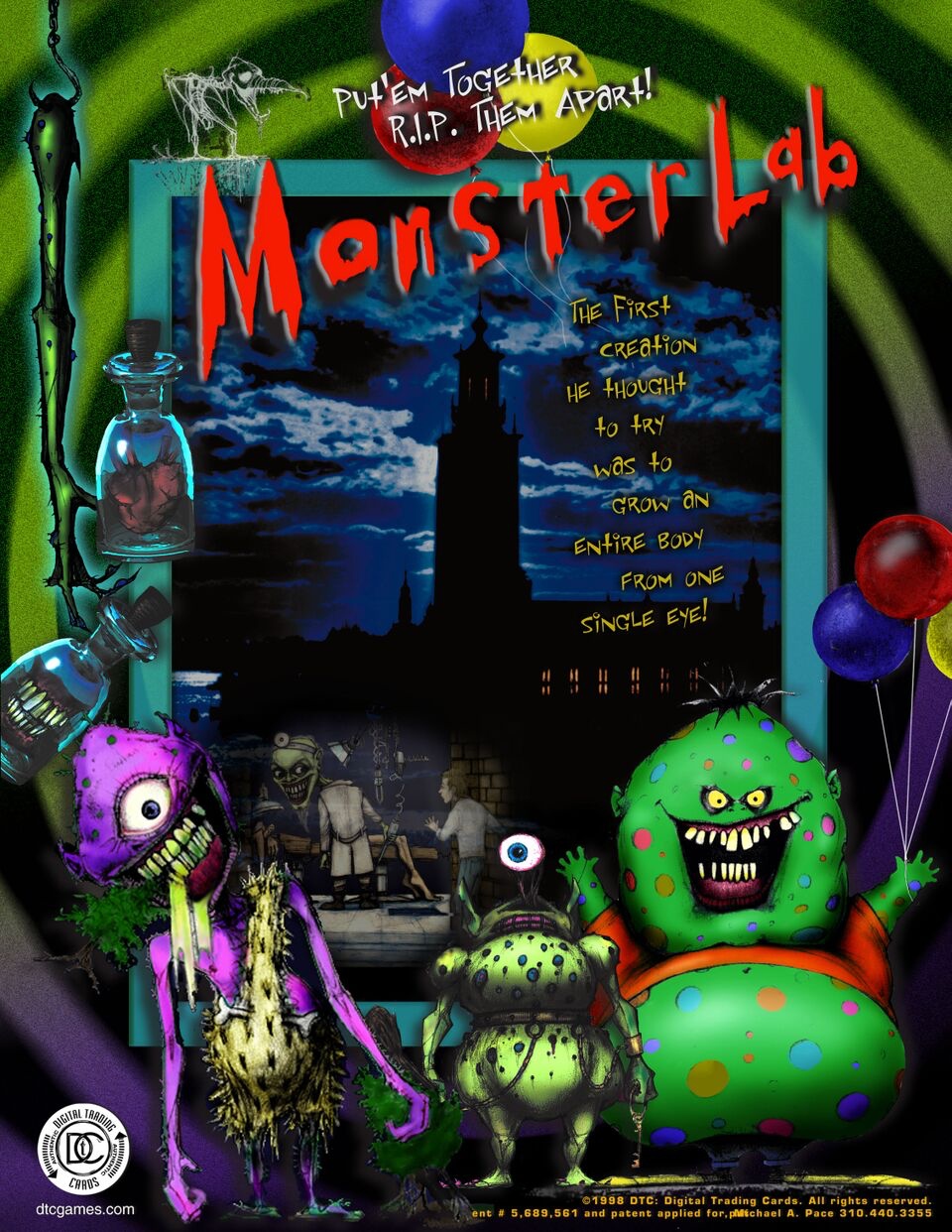
Original 1998 MonsterLab poster showing the three signature creatures, Dr. Stein's castle silhouette under stormy sky, the balloons reading 'Put 'em Together, R.I.P. them Apart!', and DTC: Digital Trading Cards branding.
Put 'em Together.
R.I.P. them Apart.
— Original tagline · Michael A. Pace · ©1998 DTC: Digital Trading Cards

Origin

A fighting game with a creator economy, pitched in 1999.

MonsterLab was conceived by Michael A. Pace as the premier fighting game for the SEGA Dreamcast — combining 3D combat with a deep creation system where every monster part was a collectible Digital Trading Card. Players would build, modify, battle, trade, and barter parts both locally and online, years before live-service collectible economies became standard.

The high concept

Monsters consist of six main parts — a torso, a head, two arms, two legs. Each part is a DTC: Digital Trading Card with its own colors, textures, shapes, and attributes. Win a battle, take an opponent's part. Lose, give one up. Trade or buy missing parts online or in retail.

The fighting style was deliberately closer to Clay Fighter than Tekken: campy, exaggerated, full of hair-pulling, snot-blowing, noogies, and zit-popping. Wrestling with monsters, not simulation combat.

Why it mattered

  • First fighting game with a patented player-driven trading economy.
  • Designed for the Dreamcast's 56k modem — local play, modem-to-modem direct connection, and online trading at the same site.
  • Quest/Story Mode used Mario 64-style 3D exploration of Dr. Stein's castle across ten levels.
  • Sequels planned to add wings, tails, tentacles — animal parts beyond the human-like base.
  • Pitched to Warner Interactive (1997) and budgeted at $1.78M across three phases for SEGA Dreamcast (1999).

The Story

One night the doorbell rings. A three-armed, one-eyed monster hands you a manuscript.

The opening cinematic, written in 1999, frames the entire quest. The monster dissolves into slime at your feet, leaving only the eyeball. The manuscript hovers in mid-air, and Dr. Stein — dismembered, scattered across his own lab — speaks through it.

You've been chosen to save the world from a terrible fate
Make up your mind before it's too late…

Evil monsters are loose, they're ugly indeed
Roaming under my castle in abundance like weeds…

I am Dr. Stein and they've torn me apart
They've left me in pieces with no place to start…

But fear not, 'cause beneath my castle and inside my lab
You'll find good monsters in need of rehab…

Kindly put them together and call them by name
They'll fight off the bad ones and drive them insane…

With courage, collect the clues on your way
I've left them for you in the words that I say…

Find the source to defeat evil once and for all
Shut them down and make them fall…

Pick up the eyeball and feel your fate
The night is young and the monsters wait…

This power bolt will help you to fight
It will fly you to my castle on this very night…

The world is at stake so be on your way
Pick up the eyeball and save the day!

— Dr. Stein's manuscript · MonsterLab design doc, 1999
You pick up the eyeball. A lightning bolt shatters the window, wraps around your body, and hurls you to Dr. Stein's laboratory. The eyeball leaps from your hand, bounces over to Dr. Stein's dismembered head, and briefly brings him to life. He tells you: "The evil Dr. Von Gersdorf has stolen his Book of Monster Formulas. You must retrieve it before his monsters take over the world."

The Cast

The mad scientists, the assistant gone wrong, and the original monster lineup.

The 1999 design document names a small core cast and signals a roster of ten boss monsters across ten castle levels. The hero — you — is a player avatar guided by the disembodied head of Dr. Stein.

Mad Scientist · Hero's Guide
Dr. Stein

The original mad scientist of MonsterLab. Torn apart by his own creations and scattered across his castle. His dismembered head is reanimated by a single eyeball just long enough to send the player on their quest to recover the Book of Monster Formulas.

Antagonist · Final Boss
Dr. Von Gersdorf

Dr. Stein's former assistant. The traitor. Stole the Book of Monster Formulas and retreated to the deepest corner of the castle dungeon, where he now creates evil monsters and commands a horde of creatures across the castle's ten levels.

Online Service · Body Shop
Dr. Carnivorous

Runs the online Body Shop. For a small e‑money fee, he'll assemble a monster from cards you provide — for players who lack the Monster Glue or patience to build their own. The first instance of an in-game economy NPC in the MonsterLab universe.

Hero · Player Avatar
The Chosen One

The player. Pulled into the story by a power bolt the moment they pick up the eyeball. Default loadout: one monster torso with two randomly-attached appendages, plus two spare parts and Monster Glue in the meat-locker inventory.

Poster Cast · 1998
The Original Trio

The three signature creatures from the 1998 DTC poster: a tall, purple, melting beast with exposed bones; a polka-dotted three-eyed cyclops in red coveralls; and a green spotted hulk with razor teeth, holding balloons. They define the look — campy horror, hand-painted, cartoonishly gross.

Bosses · One Per Level
The Ten Level Bosses

The 1999 doc specifies ten end-of-level bosses, one per castle level. Each, when defeated, relinquishes a predetermined Super DTC — a rare trading card that can be brought online and traded in (along with the recovered Book of Monster Formulas) for a Super Monster Trading Card.

The World

Dr. Stein's castle: ten interconnected zones above and below ground.

Quest/Story Mode is a Mario 64-style first-person 3D exploration of Dr. Stein's castle and the surrounding town of Sleepytown. Below the castle lies a vast labyrinth of corridors and dungeons teeming with monsters. Each level has its own end-boss and its own arena that reappears in Versus and Online Battle Modes.

01The Dungeon Labyrinth #1
02The Dungeon Labyrinth #2
03Castle Grounds #1
04Castle Grounds #2
05Sleepytown Square
06Sleepytown Graveyard
07The Castle Roof
08The Castle Ballroom
09The Castle Courtyard
10The Castle Gardens

The Laboratory (HQ)

Default starting location. On one wall: a door to the Meat Locker — your inventory of monster parts hanging from hooks, alongside a can of Monster Glue. On the opposite wall: the huge door to Quest/Story Mode.

The Meat Locker

The inventory. Every item — torso, head, arm, leg, glue can, monster-enhancement formula — appears as a hanging DTC: Digital Trading Card. Two check boxes per card: connection status, and willing-to-trade.

The Three Sciences

Mechanical. Biological. Alchemical. The castle's three labs and a rock-paper-scissors of mad science.

The expanded framing of the world divides the castle HQ into three labs — one for each branch of mad science. Each lab is run by its own mad scientist, each produces a class of monster parts, and each is strong against one branch and weak against another.

Mechanical

The Workshop · The Lab

Makes mechanical parts — gear-and-steam Victorian contraptions or shiny futuristic chrome. Pistons, hydraulic claws, rivets, brass plating.

Strong against: Biological

Biological

The Bio Chamber

Living parts. Heavy on plants, human flesh, animal tissue. Vines, tendrils, organs, fur, claws, teeth — the organic horror that defined the original 1998 poster.

Strong against: Alchemical

Alchemical

The Arcanium

Summoned magic parts. Undead bone, elemental fire/ice/storm, mythical-creature components — dragon scale, phoenix wing, troll knuckle. Pure spellcraft made physical.

Strong against: Mechanical

How a part gets made

Ingredients drop from defeated enemies and from mini-games scattered through the castle. Bring the ingredients to one of the three mad scientists' labs and play a lab-specific mini-game to combine them into a finished head, torso, arm, or leg. Then carry the part to the Monster Building Mode in Dr. Stein's lab — apply Monster Glue, attach it to a torso, name your creation, and save.

Part attributes (from 1999 doc)

  • Health
  • Agility (speed)
  • Strength (physical attack)
  • Armor (physical defense)
  • Magic (attack)
  • Resistance (magical defense)
  • Special powers (varies per part)

Each attribute is scored 0–100. Monster-enhancement formulas, found throughout the castle, permanently modify a single DTC's attributes when applied.

Monster Glue economy

  • One can = one appendage attached to one torso.
  • Glue supply is limited inside Quest/Story Mode.
  • This forces players to commit to combinations instead of slapping parts together randomly.
  • Out of glue? Trade, or pay Dr. Carnivorous to assemble your monster online.
  • Once glue or a formula is used, the DTC is consumed from inventory.

The 1999 Design Document

18 pages of the original SEGA Dreamcast pitch from EMA Multimedia.

The complete game design document, dated 1999 and copyrighted by EMA Multimedia, Inc. Covers high concept, hooks, story, gameplay, all five game modes (Quest/Story, Local Battle, Versus, Monster Building, Local Trading, Online), DTC trading and bartering UI, Dreamcast controller layouts, security architecture for the patented memory-card system, and a $1.78M three-phase production budget. Below: the contents and the production summary.

Contents

  • High Concept Overview
  • The Hooks
  • The Story (Dr. Stein's manuscript)
  • Gameplay
  • Modes — Quest/Story, Single-Player Battle, Versus, Monster Building, Local Trading, Online (Battle / For Trade / Browse for Parts / Barter)
  • Buying DTC: Digital Trading Cards™
  • Fighting (camp moves: hair pulling, noogies, zit popping)
  • Inventory, Save Game, Save Cards/Parts
  • Camera (1st-person POV with zoom-out to 3rd person)
  • Dreamcast Controller Layout (front-end / battle / quest)
  • Security (memory-card header anti-copy plan)
  • Conclusion

Production plan

  • Design phase — 4 weeks · $33,800 · Full game script, conceptual art, storyboards, prototype schedule
  • Prototype phase — 12 weeks · $150,000 · Engine demo, rendering tests, at least one main character built, several characters and environments by week 12
  • Production phase — 15 months · $1.6M · Alpha at month 12, Beta at month 14, Gold Master at month 15
  • Total budget — $1,784,000, structured as advances against future royalties
  • Team — Producer, Asst Producer, Lead Game Designer, Game Designer, Lead Programmer, 5 Programmers, Lead Artist, 5 Artists, Sound Designer, Art Director

The intellectual property

DTC: Digital Trading Cards™ is the patented underlying technology. Patent #5,689,561 issued 1998; additional patents applied for. Copyright held by Michael A. Pace through DTC: Digital Trading Cards (1998) and assigned to EMA Multimedia, Inc. for the MonsterLab title (1999).

Origin domain: monsterlab.com, registered November 22, 1996.

The Through-Line

What carries forward from 1996 to the new MonsterLab.

Kept (canonical)

  • The tagline: Put 'em Together. R.I.P. them Apart.
  • Dr. Stein, Dr. Von Gersdorf, Dr. Carnivorous
  • The castle HQ + Sleepytown world
  • Six-part monsters (head, torso, two arms, two legs)
  • Collectible parts as the core economy
  • Campy, hand-painted, Clay Fighter-style horror
  • Online trading, battling, bartering

Evolved (modern reboot)

  • DTC → AI digital canvas: parts are generated on demand
  • Three Sciences framing: Mechanical / Biological / Alchemical
  • Three rival mad scientists with their own labs
  • Rock-paper-scissors damage triangle
  • Browser-playable; no Dreamcast modem required
  • Sequel-promised wings/tails/tentacles available from day one
  • Connectivity over memory cards — cloud-native trading